News Story
Researchers publish human auditory system study in PLoS Biology
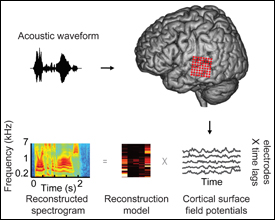
Participants listened to words (acoustic waveform, top left), while neural signals were recorded from cortical surface electrode arrays (top right, red circles) implanted over superior and middle temporal gyrus (STG, MTG). Speech-induced cortical field potentials (bottom right, gray curves) recorded at multiple electrode sites were used to fit multi-input, multi-output models for offline decoding. The models take as input time-varying neural signals at multiple electrodes and output a spectrogram consisting of time-varying spectral power across a range of acoustic frequencies (180–7,000 Hz, bottom left). To assess decoding accuracy, the reconstructed spectrogram is compared to the spectrogram of the original acoustic waveform. Photo courtesy PLoS Biology.
”Reconstructing Speech from Human Auditory Cortex” details recent progress made in understanding the human brain’s computational mechanisms for decoding speech. The researchers took advantage of rare neurosurgical procedures for the treatment of epilepsy, in which neural activity is measured directly from the brain’s cortical surface—a unique opportunity for characterizing how the human brain performs speech recognition. The recordings helped researchers understand what speech sounds could be reconstructed, or decoded, from higher order brain areas in the human auditory system.
The decoded speech representations allowed readout and identification of individual words directly from brain activity during single trial sound presentations. The results provide insights into higher order neural speech processing and suggest it may be possible to readout intended speech directly from brain activity. Potential applications include devices for those who have lost the ability to speak through illness or injury.
Brian N. Pasley, Helen Wills Neuroscience Institute, University of California Berkeley is the paper’s lead author. In addition to the University of Maryland co-authors, additional co-authors include Robert Knight, University of California San Francisco and University of California Berkeley; Adeen Flinker, University of California Berkeley; Edward Chang, University of California San Francisco; and Nathan Crone, Johns Hopkins University.
* Stephen David is now an assistant professor at Oregon Health & Science University, where he heads the Laboratory of Brain, Hearing, and Behavior in the Oregon Hearing Research Center.
** Nima Mesgarani is currently a postdoctoral researcher in the Neurological Surgery Department of the University of California, San Francisco School of Medicine. He won ISR’s George Harhalakis Outstanding Systems Engineering Graduate Student Award in 2007.
| Read a story about this research in USA Today |
Published February 2, 2012
Related Stories
Stories / November 30, 2018
Stop—hey, what’s that sound?
Stories / September 25, 2018
NSF funds Shamma, Espy-Wilson for neuromorphic and data-driven...
Stories / May 30, 2014
Presacco, Heffner, Smith to represent Maryland at Universitas 21
Stories / December 23, 2011
Auditory researchers publish sensory processing research in PNAS
Stories / June 9, 2011
Shamma, Kanold receive DURIP funding
Stories / July 14, 2010
Article by auditory researchers appears in Nature Neuroscience
Stories / July 21, 2009
Alumna Mounya Elhilali wins NSF CAREER award
Stories / September 26, 2023
New UMD Division of Research video highlights work of Simon,...
Stories / May 5, 2023
Two ECE Graduate Students Win 2023 UMD Three Minute Thesis...
Stories / December 15, 2022
Alum Sidiropoulos receives three IEEE Signal Processing Society...