News Story
Giving Robotic Flight More Buzz
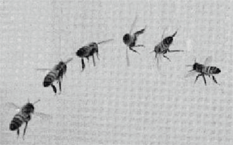
Researchers in a lab down the hall from the dean's office have situated the colony there so they have easy access to the bees. They are studying how the bees fly in order to enable micro air vehicles (MAV) to deal with unexpected wind changes. The MAVs someday could be used for search and rescue, defense and other applications.
To study the bees in flight, the researchers built a small-scale wind tunnel that subjects the insects to varying wind disturbances. The researchers film the bees using high-speed videography and slow down the resulting video, so they can observe the minutest changes in the bees' wing movements while compensating for wind gusts.
“Insects fly in very dynamic and uncertain environments. By replicating these conditions in the lab, we can identify mechanisms that enable insects’ robust flight performance,” said Jason T. Vance, a biologist and post-doctoral researcher in the Autonomous Vehicle Laboratory (AVL) at the A. James Clark School of Engineering on the University of Maryland, College Park, campus.
Vance said his team couples the data collected with aerodynamic modeling principles to determine what aspects of the bees' flight can be used in the MAVs.
Assistant Professor Sean Humbert (Department of Aerospace Engineering and Institute for Systems Research) runs the AVL. He is one of several researchers who last week won a Multidisciplinary University Research Initiatives award from the U.S. Department of Defense for research titled "Animal Inspired Robust Flight with Outer and Inner Loop Strategies." The research is being led by the University of Washington. The Clark School's portion of the grant is $1.48 million.
Vance and Humbert are collaborating with biologists, engineers, and other researchers in academia and the private sector to enable tiny flying robots to fly effectively in varying wind conditions. These robots eventually could be used to help gain situational awareness in dangerous and uncertain environments, such as those encountered on the battlefield or during natural disasters.
"It's a very integrative and multi-disciplinary approach for studying this principle," Vance said.
Engineers at the Glenn L. Martin Wind Tunnel on the College Park campus helped the AVL team fabricate the small-scale wind tunnel used to study the bees, which are on loan from the UM Department of Entomology.
Published July 27, 2010
Related Stories
Stories / June 1, 2023
Michael Bonthron Wins NDSEG Fellowship
Stories / April 19, 2023
Chahat Deep Singh's robot bee work featured in BBC video
Stories / March 8, 2023
The Falcon and the Flock
Stories / February 20, 2023
Alumnus Udit Halder’s work published as cover article in...
Stories / December 8, 2022
Autonomous drones based on bees use AI to work together
Stories / July 7, 2022
Alum Naomi Leonard is 2023 IEEE Control Systems Award recipient

Stories / February 14, 2022
Chahat Deep Singh named a Future Faculty Fellow

Stories / February 7, 2022
MRC and MAGE Earn ARM Institute Endorsement

Stories / December 9, 2021
Alum Nitin Sanket wins Larry S. Davis Doctoral Dissertation...
Stories / February 13, 2021
Stretchable, soft sensing skins for robots