News Story
Abshire, Shapiro, Smela part of biosensor grant
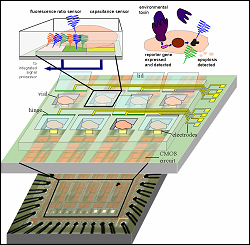
Monitoring cells on chip.
Assistant Professor Pamela Abshire (ECE/ISR), Associate Professor Benjamin Shapiro (AE/ISR), and ECE-affiliated Associate Professor Elisabeth Smela (ME) will be contributing their research on cell-based sensors to the project. "Handheld Cell-Based BioSensor for Complex Samples" will develop a miniaturized analysis system that could be used in industrial, environmental and clinical fields.
The problem with biochemical weapons detectors is their unacceptable number of false positives. Existing detectors are easily fooled because they cannot distinguish between the subtle ways pathogens interact with biological systems. To solve this problem, Shapiro, Abshire and Smela's research uses biological systems that incorporate real cells to spot the pathogens.
The cells are exposed to potential pathogens in the air via a semi-permeable membrane. Much like a canary in a coal mine, these cells die when exposed to a particular pathogen, triggering an early warning. They also are engineered to produce a signal, such as fluorescence, when attacked. The system quickly realizes pathogens are present. The cells are stored on a chip that keeps them alive and monitors the light they produce.
The research won the University of Maryland's 2004 Invention of the Year Award in the physical science category. A patent application is on file with the U.S. Patent and Trademark Office.
IBI is a company developing rapid, ultra-sensitive tests to detect harmful pathogens for both the biodefense and clinical infectious disease markets. IBI began at the University of Maryland’s Technology Advancement Program (TAP) Incubator, a Clark School initiative managed by the Maryland Technology Enterprise Institute.
Published February 26, 2008
Recent Stories
Stories / Jun 24, 2026
Dean Graham Reappointed to Second Five-Year Term

Stories / Jun 23, 2026
Babadi, Dachman-Soled and Dumitras Receive Academic Promotions

Stories / Jun 18, 2026
ECE Professor Kaiqing Zhang Receives Donald P. Eckman Award

Stories / May 28, 2026
Generations of Graduates: A Full-Circle Celebration

Stories / May 26, 2026
Apply: Chair of the Fischell Dept of Bioengineering

Stories / May 13, 2026
Capstone Design Expo 2026: Students Solve for Maryland & Beyond

Stories / Apr 30, 2026
CS/ECE Professors Receive IEEE ICRA Most Influential Paper Award

Stories / Apr 27, 2026
New Lecture Series Unites Experts to Solve Critical Challenges

Stories / Mar 31, 2026
NIH Funds "Smart Pill" for Gut Health Monitoring

Stories / Mar 23, 2026
UMD to Lead DARPA-Funded Effort to Accelerate Mathematical...
