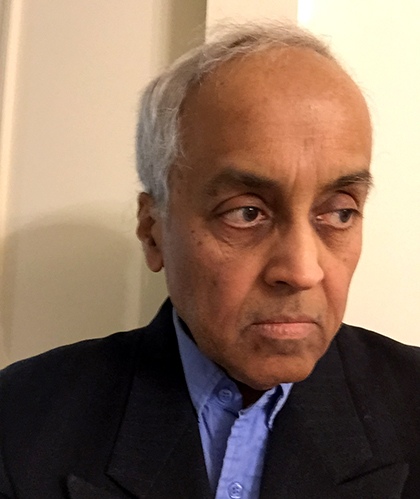
Krishnaprasad, P. S.
The Institute for Systems Research
Maryland Robotics Center
Brain and Behavior Institute
P. S. Krishnaprasad received his Ph.D. degree from Harvard University in 1977. He was on the faculty of the Systems Engineering Department at Case Western Reserve University from 1977 to 1980. He has been with the University of Maryland since August 1980, where he has held the position of Professor of Electrical Engineering since 1987, and a joint appointment with the Institute for Systems Research since 1988. He is also a faculty member of the Program in Applied Mathematics and Statistics, and Scientific Computation, and the Program in Neuroscience and Cognitive Science. Since 1987 he has led the Intelligent Servosystems Laboratory.
Krishnaprasad has held short and long term visiting positions with Erasmus University (Rotterdam); the Department of Mathematics, University of California, Berkeley; the University of Groningen (the Netherlands); the California Institute of Technology; the Mathematical Sciences Institute at Cornell University; and the Mechanical and Aerospace Engineering Department at Princeton University.
Krishnaprasad's research interests lie in the broad area of geometric control theory and its applications. His past contributions include geometry of parametrization problems in linear systems, the Lie algebraic foundations of certain nonlinear filtering problems pertaining to system identification, the Lie theory and stability of interconnected mechanical systems (e.g., spacecraft with elastic attachments, spinning rotors, and fluid-filled cavities), and symmetry principles in nonlinear control theory. He has also investigated mathematical problems in the kinematics and control of robot manipulators, the real-time control of flexible robot arms with end-point sensing, tactile perception, and the development of symbolic algebraic tools for design and control. In the last several years, his interests have drawn him to: problems of modeling, design, motion planning and control, arising in mobile robotics (legged and wheeled vehicles, autonomous underwater vehicles and autonomous aircraft); geometric methods in nonlinear dynamics; wavelet analysis for signals and systems; intelligent control architectures, in part inspired by biological paradigms such as central patterns generators and neural networks; the technology and theory of smart materials such as piezo-electric and magnetostrictive materials for use in actuation and sensing; problems of integration of actuators and sensors in control networks; and modeling, simulation, monitoring and control in semiconductor manufacturing processes, such as rapid thermal chemical vapor deposition.
A central interest in geometric control theory, geometric mechanics, Lie groups, and distributed parameter systems, guides the technical approaches taken to attack problems in the above areas. Additionally, some of this work is also linked to the experimental efforts in the Intelligent Servosystems Laboratory.
P. S. Krishnaprasad was elected a Fellow of the IEEE in 1990 for his contributions to geometric and nonlinear control and engineering education. He was appointed a 1998-2000 Distinguished Faculty Research Fellow of the University of Maryland. He was a member of a team recognized by American Helicopter Society's Grover E. Bell Award (2002) (for work on smart structures during 1991-96) bestowed on the Alfred Gessow Rotorcraft Research Center. He was the Munich Mathematical Colloquium Lecturer (October 24, 2006). He is the recipient of the 2007 Hendrik W. Bode Lecture Prize of the IEEE Control Systems Society, for fundamental contributions to the theory of control of natural and synthetic physical systems.
Honors and awards
• IEEE Control Systems Society Hendrik W. Bode Prize (2007)
• Distinguished Faculty Research Fellow (1998-2000)
• Outstanding Systems Engineering Faculty Award, Institute for Systems Research, University of Maryland (1990-1991, 2008-2009)
• IEEE Fellow (1990)
Geometric control theory and filtering theory; control of infinite dimensional systems; system identification and model reduction; geometric mechanics; dynamics of nonholonomic systems with symmetries; dynamical systems on Lie groups and optimal trajectory generation
Control problems arising in complex multi-body systems (e.g. spacecraft with deformable elastic attachments and fluid filled containers, underwater vehicles)
Problems of modeling, design, motion planning and control, arising in mobile robotics and robotic manipulation; sensors and actuators for robotic end-effectors; motion control for nonholonomic robots; under-actuated autonomous robotic vehicles; GPS-aided navigation of mobile robots
Time-frequency methods for the analysis of signals and systems (e.g. wavelet basis representations); exploitation of auditory-physiological insights in time-frequency analysis of acoustic data; independent component analysis;
Intelligent control architectures for complex systems inspired in part by biological paradigms such as central pattern generators, and space maps associated to auditory and other sensory modalities; learning binaurally directed movement; sensorimotor feedback in echo-locating bats; hybrid models for networks of sensors and actuators; languages for motion control
Technology of smart materials such as piezo-electric and magnetostrictive materials for use in actuation and sensing; nonlinear problems in such materials; hysteresis modeling and compensation; integration of such materials in structures (e.g. networking); computational methods in ferromagnetism with applications to the design of Terfenol-D actuators
Intelligent processing of materials with a special focus on semiconductor manufacturing; modeling, simulation, monitoring and control in semiconductor manufacturing processes, such as rapid thermal chemical vapor deposition; epitaxial growth of thin films and surface reconstruction in epitaxy
Dynamics and control of formations, swarming, flocking and related biological phenomena; acoustics and biological signal processing; pursuit phenomena and prey capture behavior in nature; evolutionary game-theoretic basis for strategies of pursuit; analysis of field data on starling flocks; inverse problem of reconstructing interaction laws for collectives; cognitive cost of flocking as measured by generative models from data; continuum models of flocks
Subriemannian geometry and optimal control in the study of collectives, and for the design of efficient, nanoscale heat engines; critical dynamics in field theory and related optimal control problems
The research interests described above are supported by a program of experimental investigations in the Intelligent Servosystems Lab (ISL) where, in the period 1986 – 2019, the projects included; experiments in positioning, vibration suppression and impact control of a flexible arm with embedded actuators; mechanical manipulation with a modular hand invented in ISL; a hybrid (piezoelectric-magnetostrictive) motor invented in ISL; nonholonomic robot design; a parallel linkage manipulator invented in ISL; 3-D solid modeling and graphical animation; and motor networks. The primary current emphasis in ISL is on mobile robotics and software for control of collectives of robots. A Vicon motion capture system was installed in 2013 to study collective behavior of robots, and is used to validate principles and algorithms applicable to biological and robotic collectives
Workshop honors alum Naomi Leonard
Leonard is the Edwin S. Wilsey Professor of Mechanical and Aerospace Engineering at Princeton University.Alum Fumin Zhang elected to IEEE Fellow
His citation reads, “for contributions to autonomy of robotic sensing networks and control of marine robots.”Andrew Newman’s risk-taking work leads to Data Fusion Award
At Maryland, Newman was advised by Professor P. S. Krishnaprasad.ECE and ISR alumni feature prominently at American Control Conference
Xiaobo Tan, Sean Andersson and Fumin Zhang played key roles at the conference.Alum Sean Andersson named Mechanical Engineering Department chair at Boston University
He is a former student of P. S. Krishnaprasad.Remembering Roger Brockett, 1938-2023
Brockett was an ISR founding and permanent faculty member, and a giant of control and robotics.Leading By Example: Mentorship and Collaboration
Alum Vikram Manikonda to support ECE Graduate StudentsThe Falcon and the Flock
Complex aerial displays of starling flocks mitigate the risk of predation. New paper suggests cognitive cost is a way to explore the phenomenon of the confusion effect.Alumnus Udit Halder’s work published as cover article in Proceedings of The Royal Society A
Now a postdoctoral researcher, Halder and his UIUC colleagues developed mathematical models and control based on flexible octopus arms.Alum Naomi Leonard is 2023 IEEE Control Systems Award recipient
The Princeton professor is being recognized "for contributions to applications and theory for control of nonlinear and multiagent systems."In Memoriam: 'Advisor for Life' Pravin Varaiya
Varaiya was a friend and supporter to ECE and ISR faculty and students for many years.Alum Vikram Manikonda named CTO of BlueHalo
Manikonda is the former president and CEO of IAI, acquired by BlueHalo in 2021.Nonlinear feedback dynamics research by alum Naomi Leonard featured in the New York Times
The findings recently were published in PNAS, in a special feature on political polarization.ISR gives awards to Professor Richard La, four graduate students
ISR's annual awards ceremony was held on the Iribe Building's cantilever plaza.Alum George Kantor working on AI for agricultural robotics
Kantor is leading Carnegie Mellon University’s work in a new AI Institute for Resilient Agriculture, a joint initiative of the USDA and NSF.Measuring the 'suckiness' of invasive sea lampreys
Alum Xiaobo Tan and his MSU colleagues have developed sensing panels that can record the mechanics of the attachment.Alum Dimitris Tsakiris writes soft robotics article for The Conversation
Tsakiris provides context for the breakthrough work of a research team in the Mariana Trench.NAE journal 'The Bridge' focuses on complex systems and systems thinking
This issue explores unifiability, the leveraging of approaches and capabilities from different practices and paths of inquiry to foster functional systems engineering for complex problems.Alum Xiaobo Tan named to Richard M. Hong Endowed Chair at MSU
At Maryland, Tan was advised by Professor John Baras and Professor P. S. Krishnaprasad.NASA's Perseverance launches to Mars; alumnus work aboard
Alumnus Philip Twu worked for three years on the Perserverance rover's navigation system.Alumna Sara Pohland to continue studies as NSF Graduate Research Fellow
Pohland will attend the University of California, Berkeley, pursuing research in robotics.Alum Sean Andersson promoted to full professor at Boston University
Research focuses on two very different areas: robotics, and nanobioscience and nanotechnology.Alumnus Kevin Galloway earns tenure at the U.S. Naval Academy
Galloway is a 2001 EE Ph.D., advised by Professor P.S. Krishnaprasad (ECE/ISR).ISR/ECE alumni collaborate on control paper published in PRS-A
Kevin Galloway and Biswadip Dey were advised by Professor P. S. Krishnaprasad and worked in the Intelligent Servosystems Laboratory.Discoveries from NASA's Parker Solar Probe published in Nature
ISR alumnus Philip Twu helped develop the probe at the Johns Hopkins University Applied Physics Laboratory.ISR, ECE, CS, UMIACS faculty present 12 talks at Northrop Grumman University Research Symposium
ISR faculty's eight presentations are in machine learning, science of test, cybersecurity, and IoT sensing.ISR remembers Carlos Berenstein
Berenstein, a founding faculty member of ISR, passed away Aug. 24, 2019.Alumnus Xiaobo Tan elevated to ASME Fellow
Tan was recognized for his work in robotics.Shoukry, Krishnaprasad receive NSF grant for resilient-by-cognition cyber-physical systems
The researchers will equip autonomous systems with an additional layer of intelligence to improve safety and resilience.International Workshop on Cyber Deception and Defense addresses threats and countermeasures
The workshop was sponsored by the Army Research Office, the Clark School, ECE and ISR.ECE Inducts Three New Distinguished Alumni
Ghanadan, Tan, and Viniotis inducted for leadership and meritorious contributions to engineering, humanitarian efforts, and the application of their engineering education to other disciplines.Northrop Grumman contributes research funding for third consecutive year
Krishnaprasad, Srivastava, Aloimonos each receive $75K for individual research projects.Alumnus Philip Twu's exciting career in space robotics
Twu has worked on both the Parker Solar Probe and the 2020 Mars Rover.Alumnus Xiaobo Tan named Withrow Distinguished Scholar at Michigan State
The award recognizes the scholarship of senior faculty members in the MSU College of Engineering.Alumni Naomi Leonard and Xiaobo Tan part of public lecture on underwater robotics
The lecture was part of the Halcyon Dialogues on Robotics held at AAAS headquarters in Washington, D.C.Flocks and Form
P. S. Krishnaprasad and alumnus Matteo Mischiati devise a new fiber bundle structure to describe the changing forms of flocks and underlying kinematic modes.Alumnus Fumin Zhang promoted to full professor at Georgia Tech
His research interests are in the design and control of marine robots and mobile sensor networks, as well as cyber-physical systems theory.IAI sponsors colloquium series for seventh year
The community-building series features ISR faculty speakers.Alumna Naomi Leonard wins Hendrik W. Bode Lecture Prize
IEEE Control Systems Society prize recognizes distinguished contributions to control systems science or engineering.Alum Ram Iyer promoted to full professor at Texas Tech
Iyer has research interests in systems and control theory and their applications in optics, bio-engineering, and cybersecurity of critical infrastructure systems.Alumnus Xiaobo Tan elevated to IEEE Fellow
His citation reads, “for contributions to modeling and control of smart materials and underwater robots.”Small collectives and nonlinear dynamics
New paper by Krishnaprasad, Galloway, Justh published in Proceedings of the Royal Society A.Narayan, Zhou, Schlotfeldt, Strahan win ISR outstanding awards
ISR confers awards of excellence in its annual ceremony.Four ISR students named to Clark School Future Faculty Fellow program
The program prepares Ph.D. students for academic careers in top-50 engineering schools.Alum Xiaobo Tan named 'Foundation Professor' at Michigan State
Tan develops bio-inspired underwater robots, electroactive polymer sensors and actuators.Naomi Leonard to be inducted into Innovation Hall of Fame
Clark School honoring alumna for work in cooperative controlAlumnus Xiaobo Tan promoted to full professor at Michigan State
Tan earned a 2002 Ph.D. in electrical engineering from the University of Maryland.Optimal control and strong interactions imply flock cohesion
New work suggests that copying behavior in social groups may be governed by optimal control theoryWorkshop on Geometry of Collective Behavior organized by P. S. Krishnaprasad
The workshop was part of the 53rd IEEE Conference on Decision and Control.Alumnus Matteo Mischiati is lead author of sensorimotor control study in Nature
Research shows dragonflies use predictive control strategies, not just simple reactions, to capture prey.Alum Dimitris Tsakiris improves propulsion of robotic octopus
Paper is finalist for two awards at IROS 2014.Alum Xiaobo Tan developing robotic fish to 'stalk' real fish in the Great Lakes
The MSU professor's fish will track the movements of lake trout, walleye and lake sturgeon.Srivastava, Dey, Mirsky, King win 2014 ISR Awards
Awards honor outstanding faculty, graduate and undergraduate students, and staff.Alumnus Vikram Manikonda named president and CEO of Intelligent Automation, Inc.
Alumnus earned Ph.D. with Krishnaprasad in 1997.Intelligent Automation Inc. continues sponsorship of colloquia series
First colloquium on Feb. 5 features Derek Paley.Galloway, Justh, Krishnaprasad publish chasing and flocking research in Proceedings of the Royal Society A
New models and equations aid in understanding of natural phenomena, has implications for engineered networks of robots.UAE students, Northrop Grumman engineers tour robotics laboratories
Visitors were in town for the annual AUVSI conference.Krishnaprasad, Jarzynski part of 'Information Engines' MURI
Project will develop principles and algorithms for synthetic information nanosystems.Two ECE Graduate Students Receive Inaugural Kulkarni Fellowship
Biswadep Dey and Ravi Garg receive assistance from the Kulkarni Foundation in the final stages of their Ph.D. research.IAI again sponsors colloquia series
First speaker: Steven Gabriel on Feb. 6.Alum Xiaobo Tan improves robotic fish
Fish now can glide for long distances.MERIT-BIEN and TREND Fair Showcases Undergraduate Research
More than 20 undergraduate students participate in research projects sponsored by ECE and IREAP.Krishnaprasad awarded AFOSR DURIP for collective behavior testbed
System will include mobile robots, cameras and enhanced computational resources.Alum Sean Andersson earns tenure at Boston University
Former student of P. S. Krishnaprasad has research interests in systems and control theory.Krishnaprasad delivers Princeton Baetjer Colloquium lecture
Was named to the 2012 Baetjer Colloquium Lectureship for contributions to geometric control, filtering theory, robotics and bio-inspired design.Alum Xiaobo Tan's research featured in NSF Highlight
Story features Tan's artificial muscle-enabled robotic fish.Alumna Ermin Wei featured in MIT publication
Former ISR award winner is Ph.D. student at MIT.Alum Matteo Mischiati accepts postdoc position
Mischiati will study dragonfly flight behavior at Howard Hughes Medical Institute.Alum Kevin Galloway starts postdoc at University of Michigan
Former student of P. S. Krishnaprasad will develop feedback controls for bipedal robots.Nuno Martins receives NSF grant for animal-borne wireless networks
The $1.8M grant is a collaboration with National Geographic to monitor and protect endangered species.Roger Brockett honored for devotion to graduate student advising
ISR-affiliated faculty member receives Harvard's Capers and Marion McDonald Award for Excellence in Mentoring and Advising.Intelligent Automation, Inc. to sponsor colloquia series
IAI president and ISR alumnus Vikram Manikonda announces generous support.ISR's busy November: NSF site visit, 25th anniversary dinner, SAC meeting
The Institute for Systems Research held three major events from Nov. 17–19.ISR postdoc Chen Chiu wins outstanding paper prize
Journal of Experimental Biology names article on bat flight behavior best of 2010.Galloway, Gregorczyk, Gremillion awarded L-3 Graduate Research Fellowships
Fellowships support Ph.D. candidates working in specific research areas.Krishnaprasad, Cavagna begin new AFOSR collective behavior research
Flocks and swarms of birds and insects will be studied to discern underlying principles, build models and algorithms.Chiu, Reddy, Xian, Krishnaprasad and Moss publish in Journal of Experimental Biology
Research examines behavior among competing bats.Alumnus Xiaobo Tan Earns Tenure at MSU
Tan, a 2002 ECE alumnus, has been promoted to Associate Professor of ECE at Michigan State University.Alum Fumin Zhang wins ONR Young Investigator Program award
Former student of P.S. Krishnaprasad is one of only 17 recipients nationwide.Alumnus Xiaobo Tan receives MSU Teacher-Scholar Award
Assistant professor one of six to win the early career award.Sezmi launches customer pilot in Los Angeles
Alumni Buno Pati and Phil Wiser founded the start-up TV network.Alum Xiaobo Tan receives new autonomous robotic fish grant
The highly maneuverable, energy-efficient gliding fish will monitor aquatic environments.Alumnus Fumin Zhang wins NSF CAREER Award
Research aims to better control tasks supported by embedded computing devices and batteries.ISR alumnus Buno Pati to be inducted into Clark School Innovation Hall of Fame
Pati will be honored for developing phase-shift lithography.Alumnus Xiaobo Tan to Lead New NSF Program for Secondary School Teachers
"Research Experiences for Teachers" will focus on biology-inspired technology and systems.Honda's Tetsuaki Nakano, Kensuke Iwanaga give final presentations
ISR visiting research scientists spoke on bipedal locomotion; bipolar junction transistors.Alumnus Sean Andersson receives NSF CAREER Award
Research will focus on nonlinear control for single molecule tracking.ISR awards ceremony honors faculty, graduate student, staff member
Five individuals honored for outstanding contributions in 2008–2009.Alumnus Narasingarao Sreenath promoted to full professor at Case Western Reserve
Sreenath directs Case Western's Complex Systems Biology Center.Carlos Berenstein to retire in July
The Math/ISR professor gave a special lecture on May 21.Paper by Krishnaprasad, Justh, Wei published in Proceedings of the Royal Society A
Paper offers possible evolutionary basis for flight behavior in echolocating bats.Six ISR students chosen for Clark School's Future Faculty Program
The program aims to increase the number of Ph.D. graduates who obtain academic positions in prestigious engineering schools.Six ISR students selected for Future Faculty Program
Clark School program helps students prepare for academic positions.Alumnus interview: Herbert Struemper
The 1997 ECE Ph.D. develops mechanistic disease models for drug discovery.Manikonda Named President of Intelligent Automation, Inc.
Alumnus earned Ph.D. with Krishnaprasad in 1997.Alumnus interview: Reza Shahidi
The Qualcomm engineer talks about his career in the wireless communication industry.Alumnus Tan Presents Research at Capitol Hill Science Funding Event
Xiaobo Tan, assistant professor at Michigan State, showcased his research at a June event in DC.Krishnaprasad gives inaugural Cymer Distinguished Lecture
Cymer Center for Control Systems and DynamicsISR welcomes two Honda Visiting Scholars
Kensuke Iwanaga and Tetsuaki Nakano are here for 14 months.REU students spending summer in research
The 12 undergraduate students are participating in NSF's Research Experiences for Undergraduates program.Vorontsov, Koev, Wei and McKinney win at ISR awards ceremony
Quartet honored for outstanding contributions in 2007–2008.Galloway and Tjoa Awarded Summer Research Fellowships
ECE graduate students were selected for new summer research fellowships designed to support doctoral students.Alumnus interview: George Kantor
He tells us about the DEPTHX underwater robot project.Alumnus Xiaobo Tan receives ONR grant for biomimetic robotic fish
Robots are based on biological principles and incorporate biomimetic electroactive polymers.All Things Considered explores icy waters with DEPTHX
ECE/ISR alumnus George Kantor's control research contributes to autonomous underwater vehicle's success.P.S. Krishnaprasad gives Bode Lecture
Winner of 2007 Bode Prize spoke at 46th IEEE CDC Conference.Alum Andrew Newman wins Hart Prize for Development
Award is for automated collaborative dynamic retasking project.Alumnus George Kantor promoted at Carnegie-Mellon
Kantor's research also featured in Sept. 2007 IEEE Spectrum magazine.ISR's Intelligent Servosystems Lab places two summer interns at Intelligent Automation Inc.
Matteo Mischiati and Philip Twu are the first IAI interns in a new collaborative program.ISR faculty host CRCNS Principal Investigators' Meeting
Event at University of Maryland draws 130 participants.ISR alum Fumin Zhang joins Georgia Tech faculty
The 2004 ECE Ph.D. is currently a postdoc at Princeton working with Naomi Leonard.ISR alum Andrew Newman promoted at Johns Hopkins Applied Physics Lab
Former student of P.S. Krishnaprasad has been with APL since 2003.Shihab Shamma wins outstanding faculty award
Research has uncovered computational principles underlying the processing and recognition of complex sounds in the auditory system.ISR alum Ram Venkataraman Iyer earns tenure at Texas Tech
Former student of P.S. Krishnaprasad specializes in systems and control theory in the context of aerospace and smart structures.ISR alums Leonard, Tassiulas named IEEE Fellows
Both earned Electrical Engineering Ph.D.s in the early 1990s.Krishnaprasad, Baras, Moss participating in new MURI awards
ISR faculty on teams researching MANETs, sensor networks and micro air vehicles for Department of Defense.Krishnaprasad Receives IEEE Bode Prize
Clark School faculty member earns IEEE society's distinguished award in controls.Krishnaprasad delivers Munich Mathematical Colloquium lecture
Control expert speaks on "Geometric Control, Cohesion and Pursuit."ISR undergrad Travis Young named Merrill Presidential Scholar
Senior mentored by Krishnaprasad; active in Intelligent Servosystems Lab.Stealth strategy paper by Justh, Krishnaprasad published
Researchers develop simple model that represents the engagement of pursuing bats and their insect preyTwelve REU students welcomed
Summer experience gives undergrads the opportunity to work with ISR researchersBats use 'guided missile' strategy
A new study from four ISR researchers shows bats use a guided missile strategy to catch their prey.Grad student's high altitude work highlighted in GPS World
ISR grad student Luke Winternitz has co-written an article on his NASA work for GPSWorld magazine, explaining the development of a GPS receiver for high-altitude (above the GPS constellation) satellite navigation.ISR alum Xiaobo Tan wins NSF CAREER Award
ISR alum and current Michigan State University ECE Assistant Professor Xiaobo Tan has won a National Science Foundation Faculty Early Career Development (CAREER) Award for his research, "Dexterous Biomimetic Micromanipulation Using Artificial Muscles: Modeling, Sensing and Control."Berenstein, Krishnaprasad contribute to new signal processing book
Work is based on 2004 symposium honoring BerensteinAbed, Baras, Krishnaprasad, Justh speak at swarming workshop
Speakers apply natural behaviors to networked groups of autonomous vehiclesISR alum Sean Andersson joins Boston University faculty
Will be assistant professor in aerospace and mechanical engineeringVorontsov, Krishnaprasad, Justh and Beresnev receive sensor patent
Invention uses phase spatial light modulatorsISR alum George Kantor co-authors new robotics book
Principles of Robot Motion includes theory, algorithims and implementationISR collaborations with Toshiba
Toshiba researchers explore future research collaborations and reliability engineeringISR alumna Naomi Leonard delivers distinguished lecture
Underwater robotics specialist speaks at UC Santa BarbaraNaomi Leonard profiled in New York Times
ISR alumane is MacArthur Foundation Fellow.Moss is PI for "Innovative Technologies Inspired by Biosonar"
Research will study transformation of sensory information to motor commands for adaptive behaviors.Alum Naomi Leonard named as MacArthur Fellow
Sept 2004—Expert in underwater robotics research receives coveted, no-strings-attached "genius" grant.ISR's Xiaobo Tan joins Michigan State University
July 2004—Former ISR research associate to become Assistant Professor in ECE department.Carlos Berenstein honored with celebration of his career
June 2004—ISR professors among speakers at the event, hosted by George Mason University.Horiuchi, Krishnaprasad receive $286,000 AFOSR grant
Research to focus on "Neuromorphic VSLI-Based Bat Echolocation for Micro-Aerial Vehicle Guidance"Leonard is Principal Investigator
ISR alum heads investigation for the Department of DefenseISR faculty showcase research to Honeywell Labs delegation
Research of Baras, Abshire, Ghodssi, Krishnaprasad and Justh featured.Leonard conducts underwater robotics research
Team launched fleets of underwater vehicles into the Pacific OceanFaculty participating in three different MURI awards
Research includes networked control systems, hybrid smart materials and radiofrequency pulsesShamma, Horiuchi, Baras, Krishnaprasad, Moss awarded acoustic sensors contract
Team will develop intelligent and noise-robust interfaces for MEMS acoustic sensors for DARPAInstitute of Electrical and Electronics Engineers (IEEE)
- Fellow, 1990
- Cognitive Control in Collective Behavior
- Optimal control for reconstruction
- Hamiltonians for collectives
- Collectives in a testbed
- Exploring auditory processing and applications
- Echolocating bats use different pursuit strategies in different contexts
- Neural Systems Laboratory
- From Geometric Control to Collective Behavior
- Sensor Network Platform Positioning with Cyclic Pursuit
- Data Fitting using Optimal Control Methods
- Sensor Network Platform Positioning using Mutual Motion Camouflage
- Motion camouflage in a stochastic setting
- Motion camouflage with sensorimotor delay
- Modeling and Simulation of Pursuit Control Laws in Bat Prey Capture
- Optical Alignment for Intersatellite Optical Communication
- Simultaneous Diagonalization for Blind Signal Processing
- Swarms in Three Dimensions
- Vision-Based Control of an Inverted Pendulum on a Rotating Platform
- Optimal Detection of OOK Signals over Free Space Optical Channels
- Experimental Study of Curvature-based Control Laws for Obstacle Avoidance
- Directed Graphs and Motion Detection Languages for Robot Navigation
- Dynamic Sound Localization
- Formation Dynamics under a Class of Control Laws
- Control of a Magnetostrictive Actuator with Application to Micropositioning
- The MDLe Project: Towards a Universal Language for Sensor-based Feedback Control
- Behaviors of Multi-Robot Teams in MDLe
- Directed Graphs and Motion Description Languages for Robot Navigation