 Horiuchi
Group
Horiuchi
Group
(Computational Sensorimotor Systems Laboratory)
Silicon Neuroethology
Lab: A.V. Williams Bldg 2270B
(Prof.
Horiuchi's office: Room 2231)
Electrical and Computer Engineering
Institute for Systems Research
Neuroscience and Cognitive Sciences Program
(NACS)
Center for Comparative and Evolutionary
Biology of Hearing (C-CEBH)
Applied Mathematics and Scientific
Computation Program (AMSC)
University of Maryland,
College Park, MD
(301) 405-7457
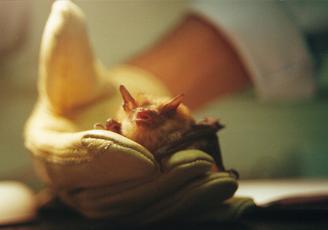
The lab's vision is to develop real-time neural models of the brain to understand how animals perceive, interact with, and learn about their environment. We are pursuing this by developing models of brains at the cellular, network, systems, and behavioral levels of abstraction and by testing these models in realistic sensory environments. Our current research is focused on the bat echolocation system, a system rich in interesting scientific questions and potential for commercial, industrial, and other applications. This is called the "Microchipoptera
Project"The Horiuchi group research consists of four main areas:
Bat Echolocation Modeling:
Using both physical models and software simulation we are striving to understand the flow and processing of ultrasonic echolocation signals in the brain that drive behavior. Part of this work is a collaborative effort with Prof. Cynthia Moss (Auditory Neuroethology Lab, UMD)
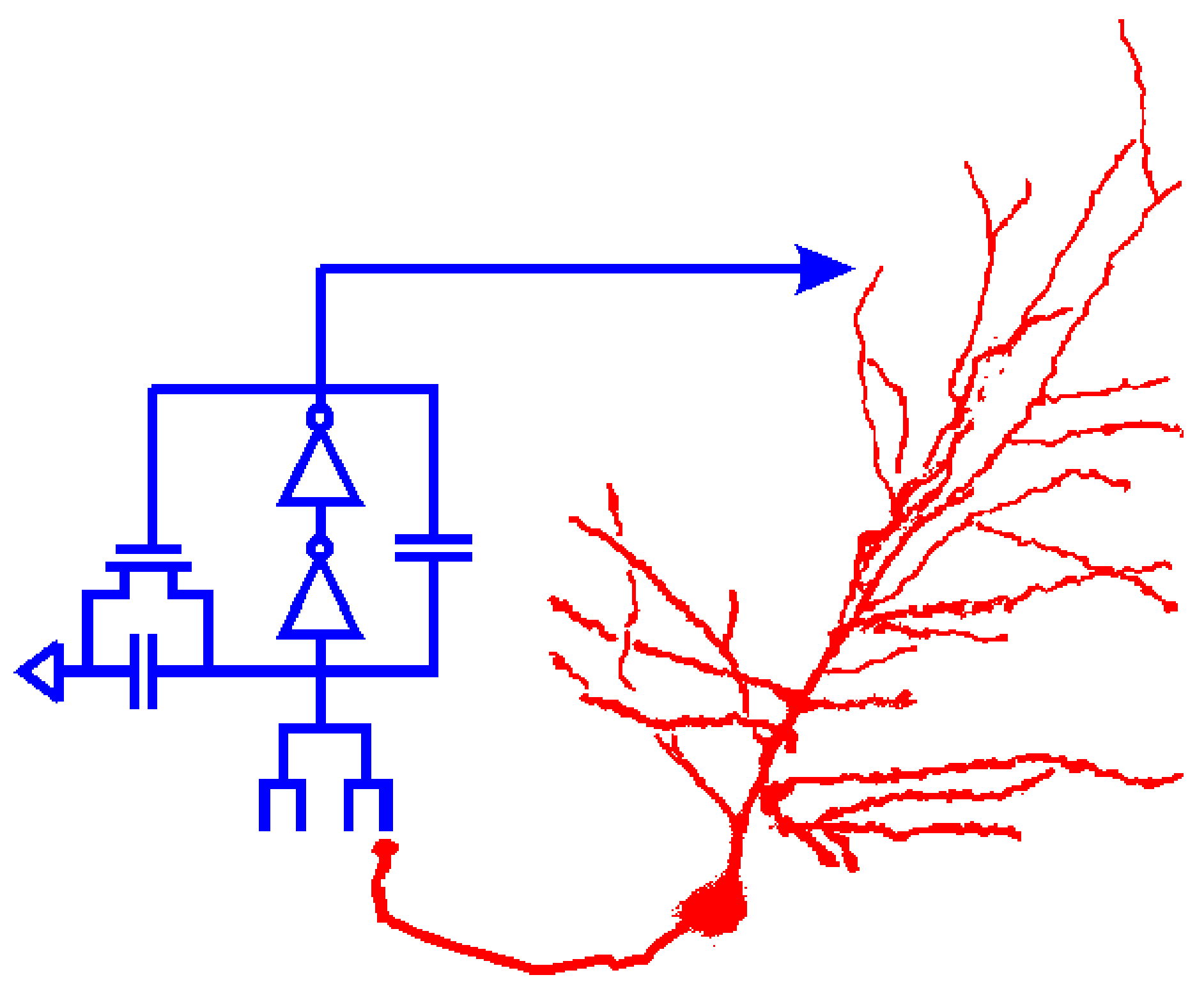
Neuromorphic VLSI Implementation (primarily analog and spike-based processing)
Starting from the simulations described above, we are designing electronic implementations of neural systems for use in real-time robotic systems to explore neurally-inspired algorithms in real environments. We are also interested in the development of low-power sensory and motor systems that could benefit the field of robotics. We are currently developing VLSI models of the bat cochlea, the echo direction-sensitive cells of the lateral superior olive (LSO), the elaboration of these direction-sensitive responses and echo delay-tuned cells of the inferior colliculus, the sensorimotor cells of the superior colliculus, and their role in controlling behavior. We are also pursuing new projects in learning on silicon to improve the performance of analog VLSI implementations and perceptual capabilities for robotics. (see some movies in 'Multimedia') [Click here to go to the Microchipoptera Project]
Neural Recording and Radio Telemetry
In a collaborative effort with the Auditory Neuroethology Lab (Cynthia Moss - Psychology Dept and with Pamela Abshire - ECE/ISR), we are developing a number of different telemetry devices to measure: bat sonar vocalizations in flight, extracellular neural responses from the bat in flight, EMG and field potentials from the muscles in flight. These will be transmitted via radio signals to a video-synchronized multi-channel data acquisition system. (see some photos in 'Multimedia')
Bat-like Sonar Motion-Planning on Mobile Robots
In addition to neuromorphic VLSI implementation of better known neural models of bat echolocation, we are also working with software simulations to develop new neural models of higher-level bat echolocation behavior. We work with slower, but more flexible computing systems that can operate on "live" sonar data to solve higher-level problems of data integration and decision making. We are exploring new ideas in neural computation where only behavioral data is currently available. [click here to go to the Batmobile page]
Assorted Other Projects:
- An EMG-controlled Tail (July 2004)
- A Low Power Horizon Detection Chip for Micro-aerial Vehicles
Lab Afilliations:
Institute for Neuromorphic Engineering
("The Institute Without Walls")
Neural Systems Laboratory (Shamma
Lab, UMD)
Telluride Neuromorphic Engineering
Workshop (Telluride, CO, USA)
The CapoCaccia Neuromorphic Engineering Workshop
(Sardinia, Italy)
Institute for Neuroinformatics
(Zurich, Switzerland)
This work is supported by grants from the following
agencies (Thanks for your support!) :
NSF (CISE, Science of Learning Centers)
AFOSR
NIMH
NIBIB / NIH
DARPA
ExpressPCB
WowWee Toys
- - - - - - - -
[CSSL Home]
This
page was updated on 12/06/04