Integrated Product and Process Design Tool for Microwave Modules
Michael Ball, John Baras, Edward Lin, Ioannis Minis, and Dana Nau
University of Maryland, College Park, MD
Ramesh Karne
Towson University, Towson, MD
Abstract: This paper describes the development of an integrated product and process design (IPPD) tool which automates a designer's tasks to design and manufacture microwave modules. This tool integrates CAD tools for product design, AI techniques for process planning, multi-objective optimization techniques (for making tradeoffs among cost, quality, lead time, etc.), and access to enterprise databases. This tool will give the designer immediate feedback on cost and productivity through generation and evaluation of alternative designs in the early design stage.
Introduction: The design and manufacture of microwave modules requires a strong and tight coordination between electronic designers, mechanical designers, and manufacturing engineers. Electronic designers develop the detailed circuitry; mechanical designers design the device to have desired dynamic, heat transfer, and strength characteristics; and manufacturing engineers select the tooling, processes, and process parameters to manufacture the module.
During each of the above stages, designers and manufacturing engineers may need to choose among competing alternatives [1, 2]. Even for a given schematic circuit, a large number of choices are available for components and processes. Components which meet given specifications could be available in many forms; for example, a resistor could be available as both leaded and surface mount, and offered by a number of vendors with differing cost and quality attributes. Different forms of components could, in turn, require different processes. The choice of manufacturing processes depends on several factors, such as the type of dielectric material, and the degree of integration of functional elements of the design. If the module includes hybrid elements, then lamination, photo mask deposition, etching, plating, adhesive deposition, application of flux, reflow soldering, trimming, cleaning, testing, tuning, drilling, milling, and casting form a superset of the operations used. If, however, some components are fabricated as integrated elements, thin film and thick film deposition techniques may be used.
It is apparent that designers are faced with a large number of options and could go through a large number of iterations between alternative designs and process plans in order to finalize a product design. Therefore, it is necessary to have a tool which will help designers to generate alternative designs, to generate process plans, to evaluate cost and quality of a design, and to manage the design process.
We are developing an IPPD automation tool for microwave modules which integrates the product and process phases of the design into a single system environment, to provide management of design work flow and immediate feedback to the designer in the early design stage. More specifically, our tool will provide the following functionality:
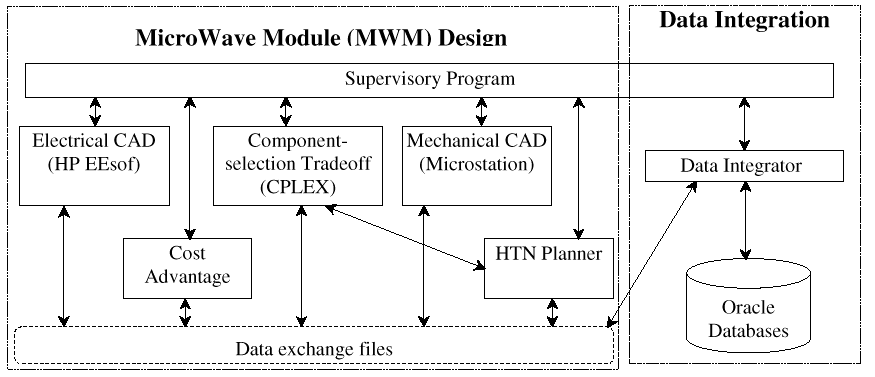
System Architecture: As shown in Figure 1, the system includes the following subsystems:
Different tools in various computer platforms exchange information through standard data exchange formats such as IGES.
Figure 1 System Architecture
Acknowledgements:
This work is supported by the NSF Grant EEC-9402384, Maryland Industrial Partnerships contract MIPS 1705.17, and the Northrop Grumann ESSD design to cost program. We would like to thank Bob Hosier and Jim Williams of Northrop Grumman for their valuable inputs to this project.
References: